

Welcome!
Our group performs experiments on quantum physics of ultracold atoms, high resolution laser spectroscopy of single trapped ions and antimatter spectroscopy. We are located at the LMU University of Munich and at the Max-Planck Institute of Quantum Optics in Garching.
If you are interested in joining our team click here!
News
of €2.5 million
In the project "High Resolution Laser Spectroscopy of Atomic Hydrogen and Deuterium" (H-SPECTR), scientists aim to measure the energies of selected transitions in the hydrogen atom with unprecedented precision. ...more

Cécile DeWitt-Morette
The experimental physicist receives the award for her substantial contributions in the field of dual-comb interferometry. The research prize is awarded annually by the French Academy of Sciences. ...more
The award honours his significant scientific achievements in the field of quantum optics and laser physics. ...more

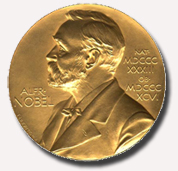
The Optica research society has announced a new scientific prize: Named after Theodor Hänsch - Director at MPQ, Professor at LMU and Nobel Laureate in Physics. ...more

She receives the price for her work on optical sensing with interfering rainbows of light waves. ...more
Dr. Nathalie Picqué and Dr. Edoardo Vicentini have been awarded the 2022 Helmholtz Prize in the category of “applied metrology” for the demonstration of digital holography with laser frequency combs. ...more
She is the first woman physicist in Germany in the field of atomic, molecular and optical physics to be awarded this renowned grant. ...more
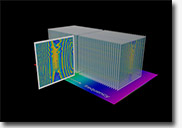
Reseachers at MPQ have just demonstrated a new technique for digital holography using two interfering frequency combs. They can now record thousands of holograms in all colours of the rainbow. ...more
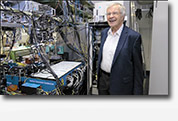
Theodor Hänsch hat so einiges erreicht: seine Liste an Preisen, Würden und Auszeichnungen ist seitenlang. Jetzt ist er 80 Jahre geworden und er ist noch kein Stück müde. ...more
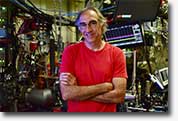
Thomas Udem is a professor at LMU Munich and one of the longest-serving members of the laser spectroscopy research group led by Nobel prize winner Theodor Hänsch. ...more
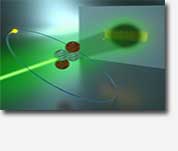
The size of the alpha particle, the nucleus of the helium atom, has been measured more accurately than ever before. Results now indicate a size 1.67824(83) femtometers, which is 4.8 times more precise than previous measurements. ...more
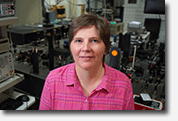
The DPG awards Nathalie Picqué with the 2021 Gentner-Kastler Prize for outstanding contributions to high-resolution broad-field molecular spectroscopy with frequency combs. ...more
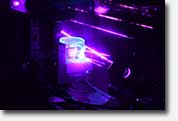
Physicists at the Max Planck Institute of Quantum Optics have tested quantum mechanics to a completely new level of precision using hydrogen spectroscopy, and in doing so they came much closer to solving the well-known proton charge radius puzzle. ...more
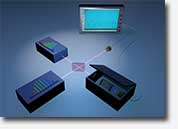
Our eyes are sensitive to only three spectral color bands, and we all know that we can no longer distinguish colors if it becomes very dark. Spectroscopists can identify many more colors by the frequencies of the light waves, so that they can distinguish atoms and molecules by their spectral fingerprints. ...more
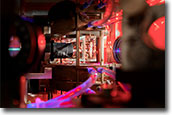
Physikern der LMU ist es in Zusammenarbeit mit Forschern der Universität des Saarlandes gelungen, eine Verschränkung zwischen den Quanteneigenschaften eines Atoms und eines Photons über 20 Kilometer Glasfaser zu erzeugen – ein neuer Rekord. ...more
© 2010, LMU München
Disclaimer